Welcome to the Coalition for Research into the Evolution of Australian Terrestrial Ecosystems (CREATE)
The Coalition for Research into the Evolution of Australian Ecosystems (CREATE) is a University of New South Wales (UNSW) Foundation.
The CREATE fund has been established to provide a focus for studies into the evolution of Australia’s Ecosystems, concentrating on the last 100 million years.
The main emphasis is on the lessons that can be learned from the past and how these can provide an understanding of the present and the key to our future.
As such it will have strong links to the Future of Australia’s Threatened Ecosystems (FATE) research/teaching collaboration at the University of New South Wales.
The objectives of CREATE include facilitating research, networking within the research community, generating research funds and communication of research outcomes to the wider public. Funds are available to support research students and contribute to research related costs, including acquisition of specimens or collections.
Click here to find out more about CREATE.
Recent publications relating to CREATE projects
- Miocene Fossils Reveal Ancient Roots for New Zealand's Endemic Mystacina (Chiroptera)and Its Rainforest Habitat by Sue Hand et al. in PLOS ONE.
- New genus of primitive wombat (Vombatidae, Marsupialia) from Miocene deposits in the Riversleigh World Heritage Area (Queensland, Australia) by Pip Brewer, Mike Archer, Sue Hand and Richard Abel in Palaeontologia Electronica.
- Mammalian lineages and the biostratigraphy and biochronology of Cenozoic faunas from the Riversleigh World Heritage Area, Australia by Rick Arena et al. in Lethaia.
- A New Species of the Basal "Kangaroo" Balbaroo and a Re-Evaluation of Stem Macropodiform Interrelationships by Karen Black, Kenny Travouillon, Wendy Den Boer, Ben Kear, Bernie Cooke and Mike Archer in PLOS ONE.
- Developing a radiometrically-dated chronologic sequence for Neogene biotic
change in Australia, from the Riversleigh World Heritage Area of Queensland by Jon Woodhead et al. in Gondwana Research.
|
 |
Research showcased at CAVEPS 2015
20 September 2015
The 15th biennial Conference on Australasian Vertebrate Evolution, Palaeontology and Systematics (CAVEPS) was held in Alice Springs on 1-5 September 2015. |
More news >>
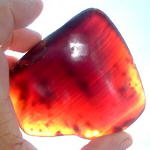
Main research program: Cape York amber
Fragments of precious amber found on the remote beaches of Cape York contain the remains of plants and tiny animals millions of years old.
Read more >>
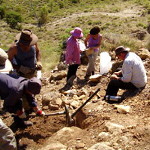
Main research program: Riversleigh
The rocks at Riversleigh are rich in well-preserved fossil remains of the ancestors of the modern Australian fauna and entirely new kinds of animals previously unknown to science.
Read more >>
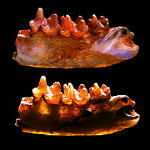
Main research program: Lightning Ridge
Deposits at Lightning Ridge in northern New South Wales yield some of the rarest, most beautiful and valuable fossils in the world.
Read more >>
Help support Australian palaeontological research
The CREATE fund has been established to facilitate and conduct research into our past. Individuals can help through donations.
Read more >>
|